

How Much Oil Can You Spill Without Clean
/https://tf-cmsv2-smithsonianmag-media.s3.amazonaws.com/filer/1b/d4/1bd4d076-95fe-4f9d-9c3d-9a63aa0452ae/header-oil-spill-mythology.jpg)
This commodity is from Hakai Mag, an online publication well-nigh scientific discipline and society in littoral ecosystems. Read more stories like this at hakaimagazine.com.
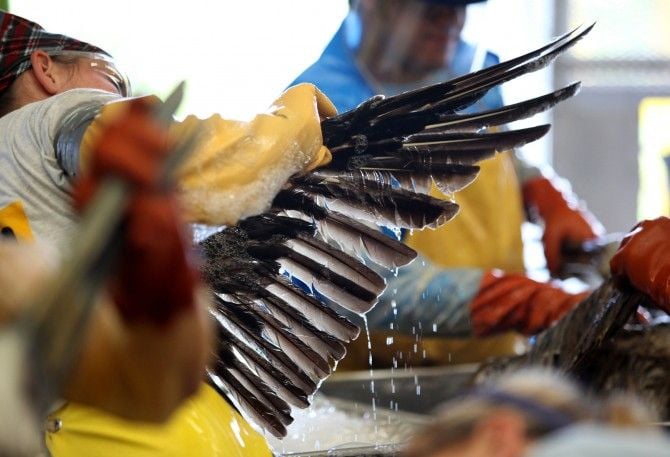
When the Deepwater Horizon well operated by BP (formerly British Petroleum) exploded and contaminated the Gulf of Mexico with at least 650 million liters of crude oil in 2022, blue-smocked animal rescuers quickly appeared on telly screens. Looking like scrub nurses, the responders treated oil-coated birds with charcoal solutions, antibiotics, and dish soap. They besides forced the birds to swallow Pepto-Bismol, which helps absorb hydrocarbons. The familiar, if non outlandish, images suggested that something was being cleaned up.
But during the chaotic disaster, Silvia Gaus poked a large hole in that myth. The German biologist had worked in the tidal flats of the Wadden Bounding main, a region of the Due north Sea and the world'south largest unbroken system of intertidal sand and mud, and critical bird habitat. A 1998 oil spill of more than 100,000 liters in the Northward Bounding main had killed 13,000 birds inWattenmeer national park, and the scientist had learned that cleaning oil-soaked birds could be every bit harmful to their immune systems as the oil accumulating in their livers and kidneys. Kill, don't clean, she advised responders in the 2022 BP spill. Gaus then referred to scientific studies to support her unsettling proclamation. One 1996 California written report, for instance, followed the fate of brown pelicans fouled past oil. Researchers marked the birds after they had been "cleaned" and released them into the wild. The majority died or failed to mate again. The researchers ended that cleaning brown pelicans couldn't restore them to proficient breeding health or "normal survivability." Another report from 1997 observed that once birds affected by an oil spill had been cleaned, they fared poorly and suffered higher than expected mortality rates.
And, consider the 2002 sinking of the MVPrestige. The tanker split up in half off the coast of Spain, spilling more than than 70 meg liters of highly toxic bunker fuel that coated more than than 600 beaches with oil. The catastrophe killed some 300,000 seabirds. Although response teams diligently cleaned thousands of animals, about of the birds died within a calendar week. Only a few hundred always fabricated it dorsum to the wild. In fact, said Gaus, studies indicate that, in general, the post-handling survival rate of oil-soaked birds is less than i pct.
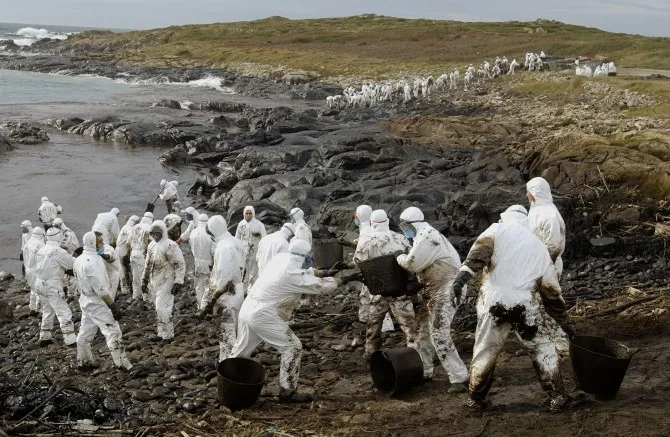
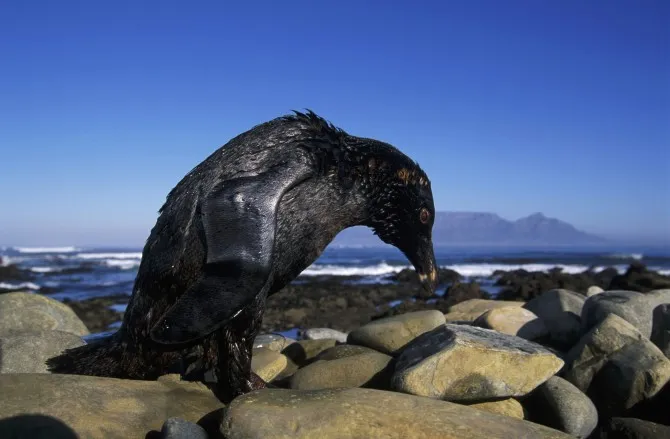
Not all bird cleaning is futile. Rescuers saved thousands of penguins following the MVTreasure spill off S Africa in 2000, for example. Success stories, however, are rare. In the Gulf of Mexico, the behemothic BP spill probably killed nearly a one thousand thousand birds. Gaus'south comments highlighted two uncomfortable realities: cleaning oily birds is a risky concern, and the marine oil spill cleanup tin ofttimes exercise more harm than adept.
In many respects, society'south theatrical response to catastrophic oil spills resembles the mode medical professionals respond to aggressive cancer in an elderly patient. Considering surgery is available, information technology is ofttimes used. Surgery also creates the impression that the health care system is doing something even though it tin't alter or reverse the patient's ultimate condition. In an oil-based social club, the cleanup delusion is likewise irresistible. Simply as it is difficult for us to acknowledge the limits of medical intervention, society struggles to admit the limits of technologies or the consequences of energy habits. And that's where the land of marine oil spill response sits today: information technology creates picayune more than an illusion of a cleanup. Scientists—outside the oil industry—call it "prime number-time theater" or "response theater."
The hard scientific reality is this: a large spill is almost impossible to incorporate because it is physically impossible to mobilize the labor needed and electric current cleanup technologies in a timely style. When the city of Vancouver released a report in 2022 on the effectiveness of responses to large tanker or pipeline spills along the southern declension of British Columbia, the decision was blunt: "collecting and removing oil from the sea surface is a challenging, time-sensitive, and often ineffective process," fifty-fifty in calm water.
Scientists have recognized this reality for a long fourth dimension. During the 1970s when the oil manufacture was poised to invade the Beaufort Ocean, the Canadian government employed more than 100 researchers to gauge the impacts of an oil spill on Chill ice. The researchers doused sea ducks and ring seals with oil and set pools of oil on fire nether a variety of ice atmospheric condition. They also created sizable oil spills (ane was most sixty,000 liters, a medium-sized spill) in the Beaufort Ocean and tried to contain them with booms and skimmers. They prodded polar bears into a human-fabricated oil slick only to detect that bears, like birds, will lick oil off their matted fur and afterwards die of kidney failure. In the end, the Beaufort Sea Project concluded that "oil spill countermeasures, techniques, and equipment" would accept "limited effectiveness" on ice-covered waters. The reports, however, failed to stop Chill drilling.
Part of the illusion has been created by ineffective technologies adopted and billed by industry as "globe form." Always since the 1970s, the oil and gas industry has trotted out four basic means to deal with ocean spills: booms to incorporate the oil; skimmers to remove the oil; fire to fire the oil; and chemical dispersants, such as Corexit, to break the oil into smaller pieces. For small spills these technologies tin sometimes brand a difference, merely only in sheltered waters. None has e'er been constructive in containing large spills.
Conventional containment booms, for instance, don't work in icy h2o, or where waves run amok. Burning oil just transforms 1 grave problem—water pollution—into sooty greenhouse gases and creates air pollution. Dispersants but hide the oil past scattering small droplets into the water column, yet they ofttimes don't even do that since conditions have to be only right for dispersants to work. Darryl McMahon, a managing director of RESTCo, a business firm pursuing more effective cleanup technologies, has written extensively about the trouble, and his opinion remains: "Sadly, even afterwards over 40 years experience, the outcomes are not acceptable. In many cases, the strategy is nonetheless to ignore spills on open h2o, only addressing them when the slicks reach shore."
The issue partly boils downwardly to scale, explains Jeffrey Brusque, a retired National Oceanic and Atmospheric Administration research pharmacist who studied the aftermath of the 2022 BP disaster too equally the Exxon Valdez spill in Prince William Sound, which grew at the alarming rate of half a football field per second over ii days. "Get endeavour and command something like that," says Curt. Nevertheless almost xxx years after the Exxon Valdez contaminated much of Prince William Sound, the cleanup technology has changed little.
"What I discover the most disturbing is the trend for responsible authorities and industry to adopt technologies mainly considering of their optics and with scant regard for their efficacy," says Short. In addition, chaos rules in the aftermath of a spill. The enormous political force per unit area to exercise something routinely sacrifices any duty to properly evaluate what kind of response might really work over time, says Brusque. "Industry says 'nosotros just want to clean it up,' yet their demonstrative ability to clean information technology upward sucks."
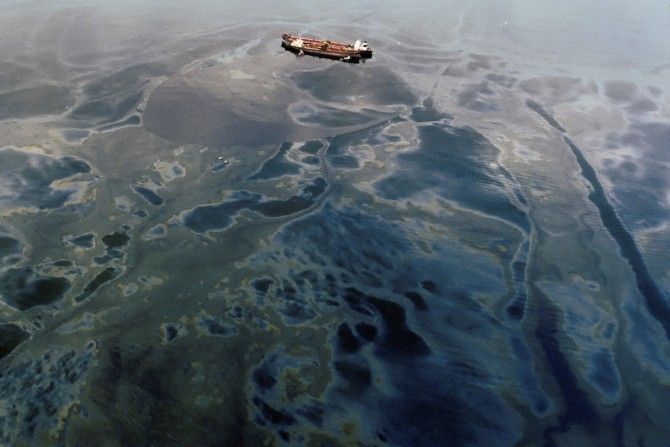
Consider, for a moment, the industry's dismal record on oil recovery. Boilerplate citizens may recollect that a successful marine oil spill cleanup actually involves recovering what has been spilled. They may also await the amount of oil recovered would increase over time every bit industry learns and adopts better technologies. But there has been little improvement since the 1960s.
During the BP disaster, the majority of the oil evaporated, dropped to the sea bottom, smothered beaches, dissolved, or remained on or just below the h2o's surface as sheen or tar balls. Some oil-chewing bacteria offered help past biodegrading the oil subsequently it had been dispersed. Crude estimates indicate that, out of the total amount of oil information technology spilled, BP recovered 3 percentage through skimming, 17 percent from siphoning at the wellhead, and 5 per centum from burning. Even and then, that's not much better than theExxon Valdez spill in 1989 when industry recovered an estimated 14 percent of the oil. Transport Canada admits that it expects only 10 to 15 per centum of a marine oil spill to ever be recovered from open water. "Even informed people are taken ashamed by these numbers," says Short.
Nor are the numbers any better for small-scale marine spills (smaller than 7,950 liters). This year, York University researchers discovered that offshore oil and gas platforms reported a total of 381 small spills between 1997 and 2022. Merely 11 spills mentioned the presence of seabirds, notwithstanding it simply takes a dime-sized blotch of oil in cold h2o to impale a bird.
Self-reporting combined with an appalling spill-recovery record underscores how poorly manufacture's preferred technologies perform in the field. Deploying dispersants, for instance, is about as constructive as cleaning oil-soaked birds and remains another case of response theater designed to hide the existent damage. During BP's catastrophic spill in the Gulf of Mexico, the company sprayed over half-dozen.viii million liters of Corexit. It was the largest volume of dispersant ever used for an oil spill and one giant chemical experiment.
Researchers take known for decades that mixing oil with Corexit rarely works. Short compares information technology to adding detergent when you're washing dishes: it produces a cloudy suspension that scatters through the water but hovers close to the top. Sweden has banned its utilize, and the United kingdom of great britain and northern ireland followed suit, based on the potential danger to workers. That didn't stop the aerial bombing of Gulf of Mexico waters with Corexit—which really killed oil-eating bacteria—considering it looked every bit if the government were doing something. Their work fabricated little difference. Bottlenose dolphins, already vulnerable, died in record numbers from adrenal and lung diseases linked to oil exposure.
"We've put the wrong people in charge of the job," says McMahon, who has charted industry's oil spill myths for years. Corexit, industry's favorite dispersant, is widely believed to contain hydrocarbon, which gives it an ominous undertone. The product was kickoff adult by Standard Oil, and its ingredient list remains a trade secret. Although the oil manufacture boasts a "rubber culture," everyone really knows that it operates with a greed culture, adds McMahon. Over the years, industry has get adept at selling an illusion by telling regulators and stakeholders whatever they want to hear nigh oil spills (in the past, executives claimed that their companies recovered 95 percent of spilled oil).
In Canada, multinational oil companies also own the corporations licensed to respond to catastrophic spills. The Western Canadian Marine Response Corporation, for case, is owned by Kinder Morgan, Imperial Oil, Beat, Chevron, and Suncor while the Eastern Canada Response Corporation is endemic by Ultramar, Shell, Imperial Oil, and Suncor. In a contempo analysis on this cozy relationship, Robyn Allan, an economist and former CEO of the Insurance Corporation of British Columbia, concluded that letting international oil companies decide the goals and objectives of marine spill preparedness and response was a flagrant conflict of involvement.
Large spills, which can destroy fisheries and unabridged communities, can impose billion dollar cleanup bills and all the same non restore what has been lost. The cleanup costs for theExxon Valdez disaster reached U.s. $ii-billion (paid by various parties), and Exxon fought the federal government'south claim for an extra $92-meg for restoration, until the government dropped their claim in 2022. To date, BP has spent more than United states $42-billion on response, compensation, and fines in the Gulf of Mexico. Meanwhile, the evidence shows that nearshore and in-port spills are four to five times more expensive to clean up than offshore spills and that heavy oil, such as bitumen, costs nearly ten times more than than light oils considering it persists longer in water. And even so, no more than CAN $1.3-billion has been set bated in Canada for a major oil spill—a sum experts observe woefully inadequate. Co-ordinate to a University of British Columbia study, a release of 16,000 cubic meters of diluted bitumen in Vancouver's Burrard Inlet would inflict at least $1.two-billion worth of damage on the local economy, which is heavily reliant on tourism and promoting its "natural" beauty. That figure doesn't include the cost of a "cleanup."
Based on the science, expecting to adequately remedy big spills with electric current technologies seems like wishful thinking. And in that location volition be no change unless responsible authorities practise iii things: give communities most afflicted by a catastrophic spill the democratic right to say no to loftier-risk projects, such as tankers or pipelines; publicly recognize that responding to a big oil spill is every bit haphazard every bit responding to a large convulsion and that in that location is no real techno-fix; and recognize that industry won't adopt more effective technologies that actually recover oil from the ocean until governments and communities properly price the risk of catastrophic spills and demand upfront multi-billion-dollar bonds for compensation. "If they spill, they must lose a encarmine fortune," says Curt.
Until those reforms take place, expect more dramatic prime-time theater on oiled body of water waters. But we shouldn't for a moment believe we're watching a cleanup. The only things beingness wiped clean are guilty consciences.
Read more coastal science stories at hakaimagazine.com.

Source: https://www.smithsonianmag.com/science-nature/oil-spill-cleanup-illusion-180959783/
Posted by: balesvilly1962.blogspot.com
0 Response to "How Much Oil Can You Spill Without Clean"
Post a Comment